1. A mighty fortress is our God,
a bulwark never failing;
our helper He, amid the flood
of mortal ills prevailing.
For still our ancient foe
doth seek to work us woe;
his craft and pow'r are great,
and armed with cruel hate,
on earth is not his equal.
2. Did we in our own strength confide,
our striving would be losing;
were not the right Man on our side,
the Man of God's own choosing.
Dost ask who that may be?
Christ Jesus, it is He;
Lord Sabaoth His name,
from age to age the same,
and He must win the battle.
3. And though this world, with devils filled,
should threaten to undo us,
we will not fear, for God hath willed
His truth to triumph through us.
The prince of darkness grim,
we tremble not for him;
his rage we can endure,
for lo! his doom is sure;
one little word shall fell him.
4. That word above all earthly pow'rs,
no thanks to them, abideth;
the Spirit and the gifts are ours
through Him who with us sideth.
Let goods and kindred go,
this mortal life also;
the body they may kill:
God's truth abideth still;
His kingdom is forever!"
1527
Story of the hymn A Mighty Fortress Is Our God
Story of A Mighty Fortress Is Our God
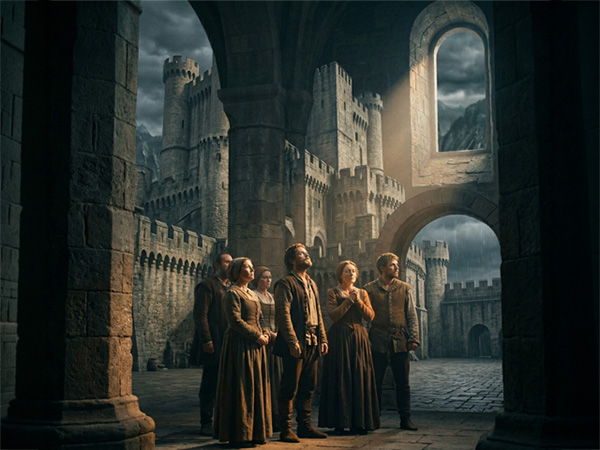
Written by Martin Luther During a Time of Crisis
Inspired by Psalm 46
A Battle Hymn of the Reformation
Date: 1527
A Mighty Fortress Is Our God - Details
Listen:
The Story Behind "A Mighty Fortress Is Our God"
The hymn is of defiance, courage, and unshakeable trust in God, written by Martin Luther during a time of crisis.
Most historians agree that Martin Luther wrote “A Mighty Fortress Is Our God” around October 1527, when the plague was approaching Wittenberg and the Reformation was under intense pressure.
This period was one of the darkest and most dangerous in Luther’s life.
Inspired by Psalm 46
The hymn is a paraphrase and celebration of Psalm 46, which proclaims God as a refuge and strength in times of trouble. Luther turned the psalm’s themes into a bold declaration that God alone is the believer's fortress,
stronger than any earthly or spiritual enemy.
A Battle Hymn of the Reformation
The hymn quickly became known as "The Marseillaise of the Reformation", a rallying cry for Protestants facing persecution. It was sung at the Diet of Augsburg, in the streets of Saxony,
by exiles leaving their homeland, and even by martyrs going to their deaths.
Its bold, confident tone mirrored Luther’s own character and the courage of early Protestant believers.
Legacy of Martin Luther
Religious Reformation: Luther founded what became Lutheranism, the first major Protestant branch. His ideas influenced Calvinism, Anglicanism, and countless other denominations. Today, Protestantism
comprises roughly one-eighth of the world's population. The Reformation splintered Western Christianity into diverse traditions, promoting personal Bible reading and priesthood of all believers.
Bible Translation and Language:
Luther translated the Bible into everyday German (completed 1534), making scripture accessible to ordinary people rather than just clergy (who used Latin). This is considered a
landmark in German literature and helped standardize the modern German language. It inspired similar efforts elsewhere, like William Tyndale's English work
A Mighty Fortress Is Our God - Video
Sing along on YouTube:
A Mighty Fortress Is Our God - Devotional
Opening Prayer
Lord God, our mighty fortress and unshakable refuge, we come to You today amid whatever floods of trouble or battles we face. Help us fix our eyes on You as our strength and helper. In Jesus' name, Amen.
Scripture Foundation
Psalm 46:1-3, 7, 11 (ESV)
"God is our refuge and strength, a very present help in trouble. Therefore we will not fear though the earth gives way, though the mountains be moved into the heart of the sea, though its waters roar and foam,
though the mountains tremble at its swelling -
The Lord of hosts is with us; the God of Jacob is our fortress. Be still, and know that I am God. I will be exalted among the nations, I will be exalted in the earth!"
Reflection
Martin Luther wrote this hymn during a time of intense spiritual and physical danger - the Protestant Reformation, when he and his fellow believers faced opposition,
threats, and the very real power of evil. Yet instead of despairing, Luther turned to Psalm 46 and declared boldly that God Himself is a mighty fortress.