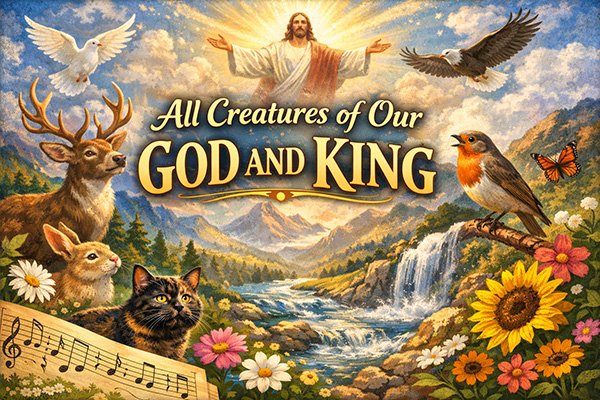
1. All creatures of our God and King,
Lift up your voice and with us sing,
Alleluia! Alleluia!
Thou burning sun with golden beam,
Thou silver moon with softer gleam!
O praise Him! O praise Him!
Alleluia! Alleluia! Alleluia!
2. Thou rushing wind that art so strong,
Ye clouds that sail in Heaven along,
O praise Him! Alleluia!
Thou rising morn, in praise rejoice,
Ye lights of evening, find a voice!
O praise Him! O praise Him!
Alleluia! Alleluia! Alleluia!
3.Thou flowing water, pure and clear,
Make music for thy Lord to hear,
Alleluia! Alleluia!
Thou fire so masterful and bright,
That givest man both warmth and light.
O praise Him! O praise Him!
Alleluia! Alleluia! Alleluia!
c. 1225
Story of the hymn All Creatures Of Our God And King
Story of All Creatures Of Our God And King
"All Creatures Of Our God And King" comes from St. Francis of Assisi's 13th‑century poem, Canticle of the Sun.
William Henry Draper paraphrased the poem into English
Hymn celebrates God's creation
Date: c. 1225
All Creatures Of Our God And King - Details
Listen:
Background and History
Born from a Medieval Poem: "The Canticle of the Sun"
The hymn began as a poetic prayer written by St. Francis of Assisi (1182–1226). Around 1225, near the end of his life,
Francis composed "Canticle of the Sun" while staying at the Porziuncola in Assisi.
It was written in the Umbrian dialect, one of the earliest forms of Italian literature, and is filled with praise for God through elements of creation.
The hymn uses family language like Brother Sun, Sister Moon, Brother Wind, and Sister Water, and expresses Francis's belief that all creation is connected under God.
It was originally a prayer of gratitude, written during a time of physical suffering but deep spiritual clarity.
How It Became a Hymn
The poem remained separate from congregational singing for centuries. Its transformation into a hymn happened in the early 20th century by William Henry Draper.
Draper was an English Anglican priest that paraphrased the poem into English between 1899 and 1919.
His version was first published in a hymnbook in 1919 to the tune: "Lasst uns erfreuen," which is a German melody from 1623.
The hymn was arranged by Ralph Vaughan Williams in 1906 for The English Hymnal.
His arrangement gave the hymn its bright, soaring, joyful character.
The pairing of Draper's text with Vaughan Williams's arrangement is what created the hymn we know today.
All Creatures Of Our God And King - Video
Sing along on YouTube:
All Creatures Of Our God And King - Devotional
Scripture Foundation
Psalm 148: This is probably the most direct and clear inspiration.
Psalm 148 is a vibrant call for all creation-from the heavens above (sun, moon, stars) to the earth below (mountains, trees,
creatures, kings, children) to praise the Lord. It literally echoes the sentiment of the hymn, inviting everything that exists to glorify God.
Psalm 104: God as Creator This Psalm celebrates God as the Creator and Sustainer of the universe, describing how He made the heavens, the waters, the earth, and all living things, providing for them and maintaining order.
The hymn's imagery of the sun, moon, stars, winds, and waters praising God aligns perfectly with Psalm 104's description of God's hand in creation.
Devotional: All Creatures of Our God and King
Think about the sheer joy in this hymn. It's a call, a grand invitation, to everything and everyone to praise God. From the sun and moon, "with golden beams and silver gleams,"
to "burning winds" and "clouds that float," Francis of Assisi's words, beautifully translated and set to music, paint a picture of a universe actively engaged in worship.
Sometimes, life can get heavy. We get caught up in our own struggles, our to-do lists, our worries. We forget to look up, to look around, and to remember the vast, beautiful,
and intricate world that God has made. This hymn is a gentle, yet firm, nudge to step outside ourselves. It reminds us that we are not alone in our praise; we are part of a cosmic choir.
When you sing "All Creatures of Our God and King," imagine yourself standing shoulder to shoulder with towering mountains, swaying trees, rushing rivers, and even the smallest
creatures buzzing around. Each one, in its own way, declares the glory of its Maker. The stars don't just exist; they "declare His glory." The wind doesn't just blow; it "hails Him."
This isn't about forced worship; it's about inherent design. God's fingerprint is on everything, and everything, by its very existence, speaks of Him. So, when we praise,
we're not just performing a duty; we're aligning ourselves with the very fabric of the universe. We're joining a song that has been sung since the dawn of creation.
Take a moment today: Step outside, if you can, or just look out a window. Notice something in nature--a tree, a bird, the sky, even a tiny houseplant. Let its simple existence
remind you of the Creator. And then, in your own way, join the chorus. Let your heart rise in praise, knowing you're singing along with "all creatures of our God and King."
"Let all things their Creator bless, and worship Him in humbleness." A great reminder for us!