1. Be Thou my vision, O Lord of my heart;
Naught be all else to me, save that Thou art.
Thou my best thought, by day or by night,
Waking or sleeping, Thy presence my light.
2. Be Thou my wisdom, and Thou my true word;
I ever with Thee and Thou with me, Lord;
Thou my great Father, I Thy true son;
Thou in me dwelling, and I with Thee one.
3. Riches I heed not, nor man's empty praise,
Thou mine inheritance, now and always:
Thou and Thou only, first in my heart.
High King of heaven, my treasure Thou art.
4. High King of heaven, my victory won,
May I reach heaven's joys, O bright heaven's Sun!
Heart of my own heart, whatever befall,
Still be my vision, O Ruler of all.
1905 (trans.)
Story of the hymn Be Thou My Vision
Story of Be Thou My Vision
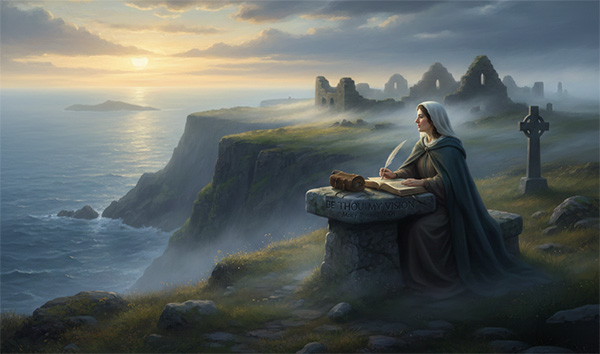
The hymn "Be Thou My Vision" has ancient roots in Irish Christianity and was brought into modern use through the translation work of Mary Elizabeth Byrne (1880–1931), an Irish scholar and linguist born in Dublin.
The poem dates back potentially as early as the 6th to 8th century
Date: 1905 (trans.)
Be Thou My Vision - Details
Listen:
Hymn Roots
The hymn "Be Thou My Vision" has ancient roots in Irish Christianity and was brought into modern use through the work of Mary Elizabeth Byrne (1880-1931), an Irish scholar and linguist born in Dublin.
The original text is an Old Irish (or Middle Irish) poem known as "Rop tu mo baile" (or variations like "Rob tu mo bhoile"), which translates roughly to "Be thou my vision" or "Be thou my ruler/home." This is a type of lorica (a protective prayer) in the Celtic Christian tradition, expressing deep devotion to God as the central focus of life: vision, wisdom, treasure, battle shield, and more.
The poem dates back potentially as early as the 6th to 8th century (scholarly estimates vary, with some sources suggesting 8th century based on manuscript evidence, though tradition links it earlier).
Translation of the hymn
For centuries, the poem remained obscure, existing in Gaelic manuscripts.
In 1905, Mary Elizabeth Byrne (then a young scholar, around 25 years old, associated with the School of Irish Learning) rediscovered and published a literal prose translation of the ancient
poem into English. She based her work on a 14th-century manuscript (primarily RIA MS 23 N 10) and published it in the academic journal
Eriu (the journal of the School of Irish Learning).
Her translation was scholarly and close to the original, rendering the repetitive, prayer-like structure of the Gaelic text
(for example, starting lines with "Be thou my..."). This was the first modern English rendering, reviving the forgotten words.
How it became a hymn
In 1912, Irish writer and folklorist Eleanor Hull (1860-1935), co-founder of the Irish Texts Society, took Byrne's prose translation, selected and adapted portions
(often condensing or selecting about 10-12 couplets), and turned it into rhyming verse form. Hull published this versified version under the title "A Prayer"
in her book The Poem-Book of the Gael.
The now-familiar hymn tune SLANE (an old Irish folk melody, originally unrelated to the text and named after the Hill of Slane associated with St. Patrick) was paired with Hull's
verses later. This pairing gained popularity, and the complete hymn as we know it appeared in hymnals starting around 1919 (for example, in the Irish Church Hymnal), with further
arrangements in the 20th century (such as by David Evans in the 1927 Church Hymnary).
Legacy of Mary Byrne
Beyond the hymn, Byrne was a foundational figure in the study of the Irish language.
Dictionary of the Irish Language: She was a key researcher and assistant for the Royal Irish Academy, helping compile the Dictionary of the Irish Language.
This remains the definitive resource for scholars of Old and Middle Irish.
Catalogs and Manuscripts: She helped catalog the vast collection of manuscripts at the Royal Irish Academy, ensuring that Ireland's literary history was organized and
accessible for future generations.
Be Thou My Vision - Video
Sing along on YouTube:
Be Thou My Vision - Devotional
Opening Prayer
Lord of my heart, as in the ancient prayer rediscovered by Mary Byrne, I come before You. Be Thou my vision today. Open the eyes of my heart to see You clearly, above every competing sight. Amen.
Scripture Foundation
"Set your minds on things that are above, not on things that are on earth." (Colossians 3:2)
"One thing have I asked of the Lord, that will I seek after: that I may dwell in the house of the Lord all the days of my life, to gaze upon the beauty of the Lord." (Psalm 27:4)
Reflection
The hymn begins with a bold request: Let nothing else matter but You. In Byrne's original translation, the prayer echoes this intensity—"None other is aught but the King of the seven heavens."
Life crowds our vision with worries, ambitions, relationships, and possessions. Yet the psalmist models single-minded pursuit: one thing above all.